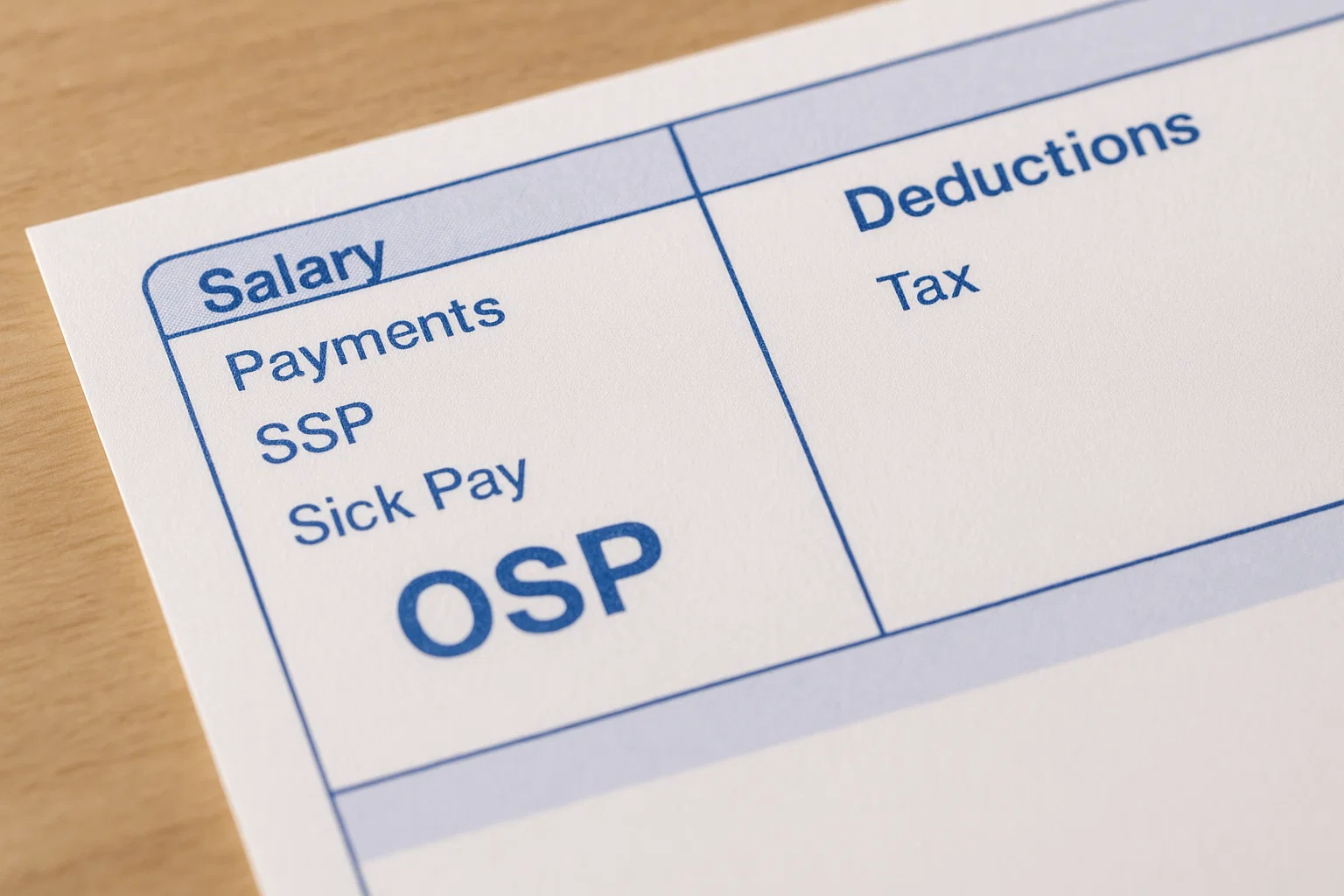
Let’s make it simple. OSP is nothing scary. It’s just your employer’s way of showing how much sick pay you’re entitled to on top of the government’s SSP, and how those payments have been adjusted inside your monthly salary. Once you understand how OSP behaves when it appears, why it shows as a deduction, and how it offsets against SSP the whole thing starts to make sense.
Here’s the part people usually miss: OSP isn’t always a payment. Sometimes it appears as a reduction or adjustment, especially if payroll is correcting something from a previous month. That’s why two payslips can look wildly different even for the same sickness period.
So let’s break the whole thing down in plain English.
What OSP Actually Means on Your Payslip
Start here, because everything else builds on this part.
OSP = Occupational Sick Pay.
It’s the sick pay your employer gives you according to your employment contract. Not every company provides it, but most medium and large UK employers do.
A simple way to think about it:
- SSP = the legal minimum sick pay from the government
- OSP = the extra sick pay your employer gives you (full pay, half pay, or a set allowance)
If you see any of these on your payslip, they all relate to OSP:
- OSP
- OSP OS
- OSP offset
- OSP adjustment
- OSP arrears
- OSP contra payment
- OSP gross reduction
They might look different depending on your payroll system (Sage, MyView, Oracle, SD Worx, iTrent… all love their own formatting).
Is OSP Full Pay? Here’s the truth
People often assume OSP = full pay. That’s not guaranteed. It depends entirely on your contract.
Many employers follow patterns like:
- Full pay for 4 weeks, then half pay for 4 weeks
- Full pay for a set number of days a year
- Full pay during probation? Sometimes yes, but many employers exclude it
- Extra OSP only with medical certificates
- OSP reduced if sickness becomes long-term
So if your payslip shows an OSP amount lower than expected, it doesn’t always mean payroll made a mistake. You may simply be in a half-pay period, or OSP may be offset by SSP.
How OSP Works When You’re Off Sick
This is where people get confused.
When you report sick leave, your employer calculates your pay in a few steps:
- Check how many days you were off
- Check your SSP eligibility
- Check your OSP entitlement (if you get any)
- Calculate how much of your salary should be paid
Here’s the part that surprises most workers:
OSP and SSP overlap. OSP often reduces itself automatically because it covers what SSP already pays.
Example:
You’re entitled to full pay under OSP.
Your SSP for that week is £116.75.
Your employer pays your normal salary, but the payslip may show:
- OSP
- SSP
- OSP offset (to prevent double-paying both)
So you still receive your usual amount, but payroll itemises it separately.
That’s why sometimes it feels like you’re “getting paid twice” but you’re not. It’s just transparent accounting.
Why Your Payslip Shows OSP Adjustment
This is the one that scares people, because adjustments look like deductions.
But don’t panic. Most adjustments are corrections, not penalties.
Common reasons for OSP adjustments:
1. Late Sick Notes
If you submitted your fit note late, payroll may have:
- Paid you fully last month
- Then corrected it this month
So it shows as OSP deduction or OSP adjustment.
2. Sick Leave Reported After Payroll Cut-Off
If your absence wasn’t processed in time, the system adjusts it next month.
This often shows as:
- OSP Arrears
- OSP Offset Arrears
- OSP Contra Payment
3. You Moved from Full Pay to Half Pay
The switch doesn’t always land neatly in one pay period.
4. You Exhausted Your OSP Allowance
Once your entitlement ends, only SSP remains so your OSP amount reduces or stops.
5. Payroll Corrected an Overpayment
If you accidentally received more OSP than you were entitled to, the system recovers it slowly or as a one-time deduction.
So adjustments don’t always mean something is “wrong.” They just mean payroll is lining up real absence data with your actual entitlement.
Are You Entitled to OSP?
Unlike SSP (which is a legal requirement), OSP is optional, meaning your employer decides their own rules.
You’re usually entitled to OSP if:
- You’ve passed your probation
- You’ve worked enough continuous service
- Your contract specifically includes OSP
- You’ve submitted proper sick notes (fit notes)
- You’re not excluded due to attendance policy issues
You might NOT get OSP if:
- You’re still in probation
- You’re on a zero-hours contract
- You’re a casual worker
- You haven’t provided medical evidence after 7 days
- Your absence falls under disciplinary review
If in doubt? Check your contract or ask HR OSP isn’t one-size-fits-all.
Understanding OSP Deductions and Reductions
When your payslip shows:
- OSP Gross Reduction
- OSP Deduction
- OSP Offset
- OSP OS
…it often means payroll is adjusting your salary to prevent double payment.
OSP Gross Reduction
This usually happens when:
- You received more OSP than you should have
- The system corrects a mistake from previous weeks
- SSP was late being applied
- Payroll is aligning full-pay vs half-pay periods
OSP Contra Payment
This essentially “balances” the account so you’re paid correctly.
Think of it like a refund, but reversed instead of giving you money back, payroll repositions what was overpaid.
OSP Offset
This is the most common one.
Offset =
Your employer subtracts SSP from OSP so you don’t get paid twice.
OSP OS
This stands for “Occupational Sick Old Scheme” or “Outside Scheme,” depending on the employer.
It simply indicates a different calculation method for OSP.
Why OSP Can Appear as a Deduction
Because payroll is recalculating your salary based on actual sickness days.
It’s not a penalty. It’s just accounting.
SSP and OSP: How They Work Together
Can you get SSP and OSP at the same time?
Yes but not as separate full payments.
Here’s how it works:
- The employer pays SSP (government minimum)
- Then the employer adds extra pay (OSP) to bring you up to the amount stated in your contract
- This appears as multiple lines but still equals your agreed pay
Let’s say your normal salary is £2,000.
If you’re off sick but entitled to full OSP:
- You receive £2,000
- Payslip may show SSP + OSP, with offsets
If you’re on half pay:
- You might receive £1,000 + SSP
- But OSP reduces itself via offset to avoid double-paying
So yes, you “get both,” but not as stackable payments.
Real Payslip Example (Explained in Plain English)
Your payslip may show something like:
- SSP: £116.75
- OSP: £300.00
- OSP Offset: -£116.75
- OSP Adjustment: -£25
- Basic Pay: £1,800
- Net Pay: £1,975
What actually happened:
- You got SSP
- Your employer added OSP
- They removed the SSP amount from the OSP line so your total stays correct
- They adjusted a previous minor overpayment
End result:
Your salary matches what your contract says just itemised differently.
What To Do If Your OSP Looks Wrong
Before running to HR, check these:
1. Count your sick days accurately
Payroll calculates based on calendar days, not working days.
2. Confirm your OSP entitlement
Full pay? Half pay? No OSP at all?
3. Check if your fit note was submitted late
Late notes often trigger automatic adjustments.
4. Compare this month with last month
Most differences come from cross-month recalculations.
5. Ask payroll for an itemised explanation
They can break down the math in seconds.
Most issues resolve quickly once you understand which days were counted and how OSP entitlement resets.
Quick Answers to Common OSP Questions
What does OSP stand for?
Occupational Sick Pay the employer-funded part of your sick pay.
Is OSP full pay?
Sometimes. It depends on your contract.
Can OSP show as a deduction?
Yes if payroll is correcting previous payments or offsetting SSP.
Can you get OSP and SSP together?
Yes. OSP usually tops up what SSP pays, not replaces it.
Why is my OSP reduced?
You may be in a half-pay period, SSP may have been late, or your allowance has ended.
What does OSP offset arrears mean?
Payroll is correcting OSP from a previous pay period due to updated sick leave data.
A final thought before you close the payslip tab
Payslips can look intimidating, especially when you’re already dealing with being unwell. But once you know what OSP is and how it pairs with SSP everything becomes easier to understand. Most of these entries aren’t penalties or deductions; they’re just payroll making sure you get exactly what your contract promises.
So next time OSP pops up on your payslip, you’ll know exactly what’s happening behind the scenes. And if anything ever feels off, HR or payroll can walk you through the numbers but now you’ll already speak their language.

Rachel combines her technical expertise with a flair for clear, accessible writing. A graduate of the University of Edinburgh, she specializes in creating detailed tech-focused content, Govt Jobs, Payslips that educates our readers about the latest in web development and SEO tools at Spinbot blog.