That’s where artificial intelligence quietly changed the game.
AI tools are no longer experimental gadgets. They’ve become everyday companions for creators who want to move faster, think bigger, and spend less time staring at a blank screen.
But here’s the real challenge. There are now hundreds of AI platforms claiming to help creators. Some are genuinely useful. Others are just noise.
So let’s slow things down and look at the best AI tools for creators and why they matter for content producers today.
What Are the Best AI Tools for Creators?
The best AI tools for creators are platforms that help generate ideas, write scripts, design visuals, edit videos, and streamline publishing. Tools like ChatGPT, Canva AI, Midjourney, Jasper, and Runway allow creators to speed up production while keeping control of creativity. Instead of replacing creators, these tools act like digital assistants that remove repetitive work and unlock new ideas.
Why AI Tools Have Become Essential for Creators
Content creation used to follow a slow rhythm.
A writer drafted an article. A designer created visuals. A video editor polished footage. A social media manager scheduled posts. Every step required a different tool and often a different person.
AI collapsed those layers.
Now a single creator can brainstorm ideas, draft scripts, generate visuals, and produce videos in the same afternoon.
That shift explains why AI tools have become essential across YouTube channels, blogs, marketing agencies, and personal brands.
Three things changed the creator workflow:
Speed
AI tools generate ideas and drafts in seconds.
Scale
Creators can produce more content without burning out.
Experimentation
Trying new formats is easier because AI removes technical barriers.
A creator who once needed a team can now operate like a mini production studio.
Which AI Is Best for Content Creators?
There isn’t one universal tool that fits every creator. Instead, creators combine several AI platforms depending on what they produce.
Some tools specialise in writing. Others focus on visuals or video editing.
Here’s a simple comparison that many creators use when choosing tools.
| AI Tool | Best For | Why Creators Use It |
|---|---|---|
| ChatGPT | Writing, scripting, research | Fast idea generation and content drafting |
| Jasper | Marketing copy | Strong brand voice and marketing templates |
| Canva AI | Graphic design | Easy visual creation for beginners |
| Midjourney | AI images | High-quality artistic visuals |
| Runway | AI video editing | Advanced video editing powered by AI |
| Descript | Audio and video editing | Simple editing for podcasts and YouTube |
| Notion AI | Productivity and notes | Organises creator workflows |
Each of these tools solves a different part of the content production puzzle.
Creators rarely rely on just one.
What Is the Number One AI Tool Creators Use Right Now?
Ask creators what tool they open first each morning and a common answer appears: ChatGPT.
The reason is simple.
It’s not limited to one task.
Creators use it for:
• brainstorming video topics
• writing blog outlines
• generating captions
• drafting scripts
• researching topics
• rewriting content
• summarising research
Instead of opening multiple apps, creators start with one conversational interface.
That flexibility explains why many consider it the number one AI tool in daily creator workflows.
It doesn’t replace specialised tools, but it connects everything together.
Which AI Tool Is Best for Creative Ideas?
Every creator eventually faces the same enemy.
The blank page.
It doesn’t matter whether you run a blog, podcast, or YouTube channel. At some point ideas run dry.
AI tools solve that surprisingly well.
When used properly, they act like brainstorming partners that never run out of suggestions.
Creators often use AI to generate:
• video titles
• article topics
• social media hooks
• thumbnail text ideas
• storytelling angles
The trick isn’t to copy AI ideas directly. Instead, creators use them as sparks.
For example, a YouTuber might ask an AI tool for ten video ideas about photography. One idea might feel interesting but incomplete. That’s where the creator steps in and reshapes the idea with personal experience.
This mix of human creativity and AI suggestions often leads to stronger ideas than either could produce alone.
Who Are the Big Four Companies Driving AI Innovation?
Behind most creator-focused AI tools stand a few powerful technology companies pushing the entire field forward.
These organisations are often described as the big four of AI.
OpenAI
The company behind ChatGPT. Known for large language models that power writing, coding, and conversational AI tools.
Google
Developing AI systems integrated into search, productivity tools, and creative platforms.
Microsoft
Investing heavily in AI infrastructure and integrating AI across software products.
Anthropic
A research company focused on building safe and reliable AI systems.
These companies supply the underlying technology that many creator tools rely on.
When a new AI breakthrough appears, it usually comes from one of these research labs before spreading into creative platforms.
The AI Tools Creators Use Most Often
Now let’s explore the specific tools creators rely on every day.
Not every tool will suit every workflow. But most successful creators combine several of them.
ChatGPT
ChatGPT has become the universal thinking partner for creators.
It helps with research, outlines, editing, rewriting, and brainstorming.
Many bloggers even use it to refine drafts before publishing.
It’s especially useful when creators need to break complex ideas into simple explanations.
Jasper
Jasper focuses on marketing copy.
While it overlaps with writing tools, Jasper shines when producing brand-driven content such as:
• product descriptions
• advertising copy
• landing page text
• email campaigns
Creators running online businesses often prefer Jasper because it understands brand voice and marketing structures.
Canva AI
Design used to be intimidating for beginners.
Canva changed that by making design drag-and-drop simple. The addition of AI features made it even easier.
Creators can now generate:
• thumbnails
• social media graphics
• presentation slides
• blog visuals
Even creators with zero design experience can produce professional-looking visuals.
Midjourney
Midjourney specialises in generating artistic images from text prompts.
Creators use it to produce:
• blog illustrations
• YouTube thumbnails
• book cover concepts
• creative artwork
It’s particularly popular among designers and visual storytellers who want unique imagery.
Runway
Video editing is often the most time-consuming part of content production.
Runway uses AI to simplify complex editing tasks.
Creators can remove backgrounds, generate visual effects, and even create video clips from text descriptions.
For video-heavy creators, tools like Runway are changing how production works.
Descript
Podcast and video editors often love Descript for one simple reason.
It edits audio and video like a text document.
Creators can remove filler words, cut mistakes, and adjust recordings simply by editing the transcript.
That dramatically reduces editing time.
Notion AI
Creators rarely struggle with ideas alone.
Organisation can also become chaotic when managing multiple projects.
Notion AI helps creators organise research, scripts, outlines, and production schedules in one workspace.
It’s especially useful for teams or creators managing several channels.
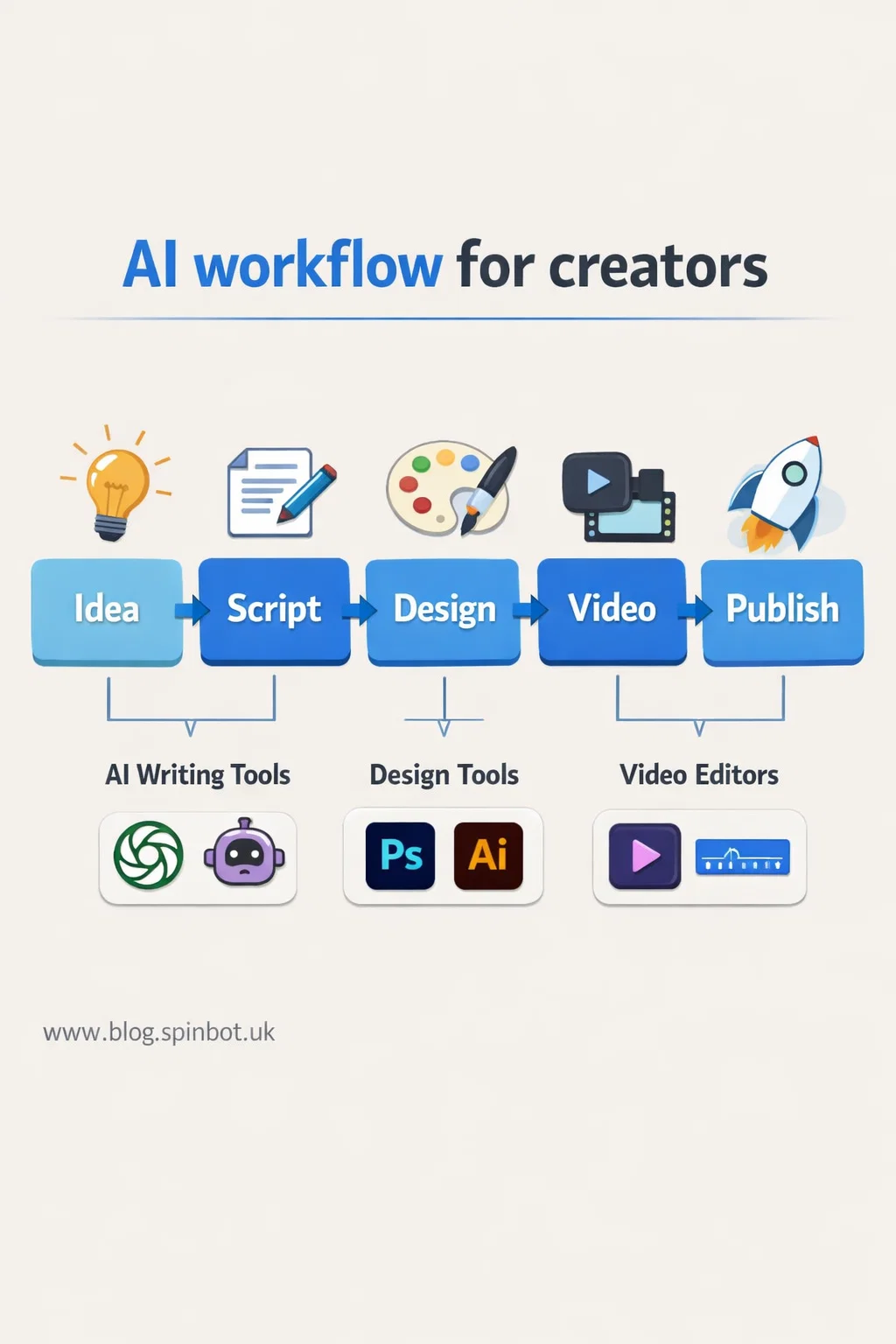
How Creators Combine AI Tools in One Workflow
A modern creator rarely uses a single tool.
Instead, they build workflows that move content from idea to publishing.
A typical AI-assisted workflow might look like this:
Idea generation begins in ChatGPT.
The creator develops a script or outline using writing tools.
Visuals are created using Canva AI or Midjourney.
Video editing happens inside Runway or Descript.
Publishing and scheduling happen inside social platforms.
The entire process that once took days can now happen within hours.
Where Tools Like Spinbot Still Help Creators
Not every AI task involves generating new content from scratch.
Sometimes creators simply need to refine existing writing.
That’s where rewriting tools remain useful.
For example, many bloggers still rely on tools like Spinbot when they want to reword text quickly or improve clarity.
These tools help creators adjust tone, simplify sentences, and repurpose older content for new audiences.
If someone wants a simple rewriting assistant, an Article Rewriter like the one available at https://spinbot.uk/ can still fit naturally into modern AI workflows.
Can AI Replace Human Creativity?
This question appears everywhere.
The short answer is no.
AI tools are powerful, but they rely on patterns learned from existing data. They don’t experience the world the way humans do.
Great creators bring something AI cannot replicate.
Perspective.
Emotion.
Experience.
A travel creator who shares a story about getting lost in a city isn’t just delivering information. They’re sharing a moment.
AI can help shape the narrative, but the story itself belongs to the human.
The best creators treat AI like a helpful assistant, not a replacement.
The Future of AI for Content Creators
The next few years will likely bring even more dramatic changes.
AI video generation is already improving quickly. Tools are beginning to create short videos from text prompts.
Audio cloning allows creators to generate voiceovers without recording every line.
Personalised AI assistants may soon manage entire publishing workflows.
But one thing will remain constant.
Creators who understand storytelling, audience needs, and clear communication will always stand out.
Technology changes.
Human creativity doesn’t.
The smartest creators aren’t asking whether they should use AI tools. That debate has already passed.
Instead, they’re asking a more interesting question.
How can these tools help them focus on what truly matters ideas, creativity, and connection with their audience.

Emily is a skilled content strategist and writer with a passion for digital marketing and SEO trends. A Leeds alumna, she brings her expertise in media communication to Spinbot UK Blog, crafting engaging content that drives traffic and enhances user engagement.